

Around the turn of the century, General Motors powertrain engineers toyed with the idea of stretching the LS engine out to 10 cylinders, and they even built a couple concept prototypes. The likely goal was a torque-laden powerplant for heavy-duty pickups. However, costs, complexity, emissions, fuel economy and other concerns all weighed against the power benefits, so GM’s market strategists looked for other directions.
Eventually, one of those concept engines landed in the shop of Darrin Gartrell, a hands-on car builder and owner of LS Brackets—a company that machines brackets for just about any type of LS application. The engine could turn over, but was hardly impressive.
“Nobody could make it run. They assumed it was this firing and that firing,” says Gartrell, explaining that the ECU acknowledged the correct 1-8-7-6-5-4-3-10-9-2 firing order but couldn’t adjust to the exact timing of the odd-fire sequence. With the help of Comp Cams, engine consultant Billy Godbold, a new intake manifold and a new ECU and tuner, the engine dyno’d out to a healthy 700 horsepower. Gartrell then shoehorned it into a ’55 Chevy—and while the hot-rod shoebox certainly caught everyone’s attention, Gartrell had higher ambitions of a 1,000 horsepower naturally aspirated for the V10 concept.

“At 2,500 rpm it was making 680 lb-ft of torque, and then still making 680 at 7,000 rpm,” remembers Gartrell. “Because of the torque curve, I decided I was going to make one in our own design to put out in the market.”
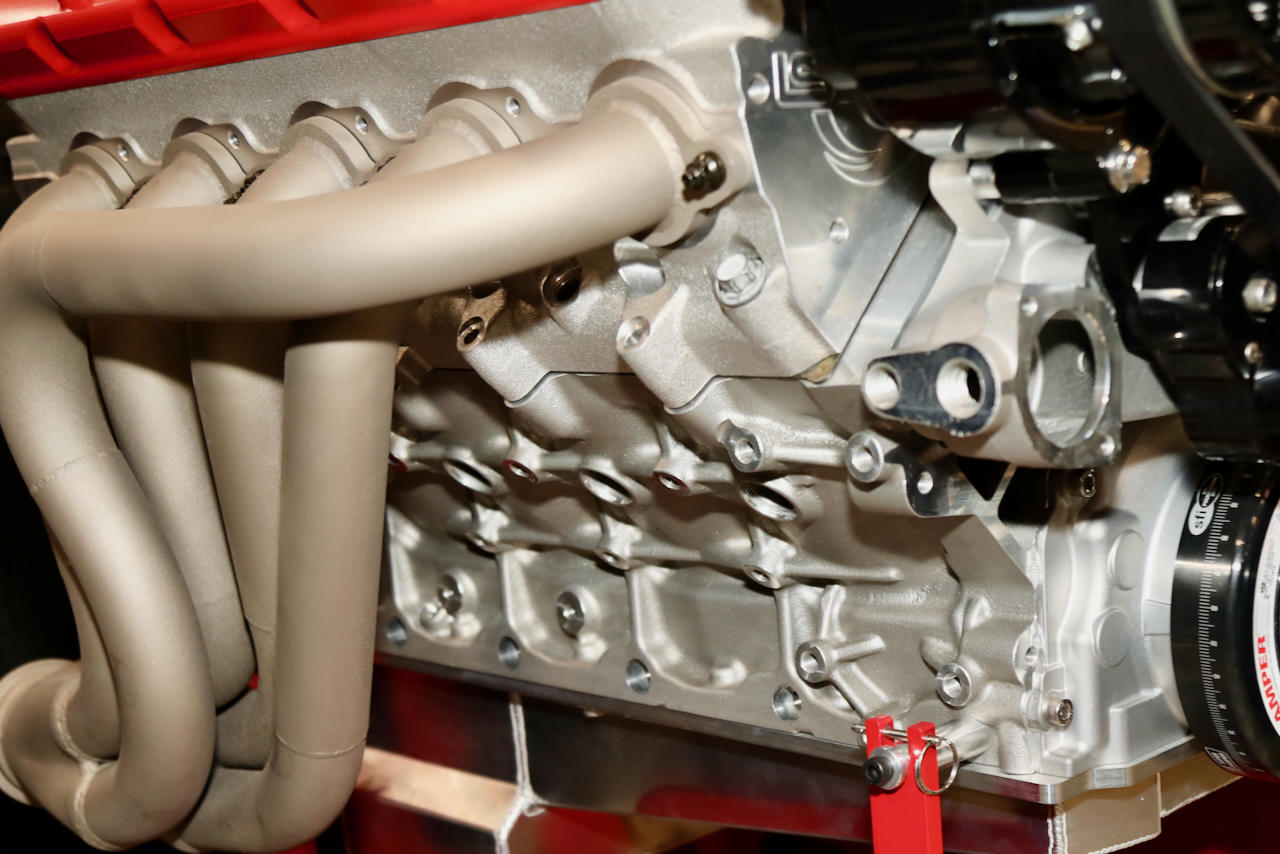
After more than five years of development, the V10 was launched at 2025 SEMA under the banner of XR10 Motorsports. The package on display measures out to 534ci with a 4.125-inch bore and 4.000-inch stroke. Recent tests on engine builder Gerald Brand’s dyno confirmed a 1,000-plus horsepower reading with peak torque over 730 lb-ft, but there’s still more tuning, camshaft tests and work with different intake manifolds—including an ITB design that makes the V10 look like an F1 engine on steroids.
The cylinder block and head were designed by Dr. Rick Roberts, who used to be the lead engineer at Edelbrock. The block is cast from A356-T6 aluminum and weighs 117 pounds bare. It features the conventional 4.400-inch bore spacing but has a 9.720-inch deck height—making it possible to build a displacement up to 634ci. The cylinder liners are longer-than-normal at 6.380-inch to help keep the piston in the cylinder with stroker crankshafts.

Other block features include .388-inch raised cam centerline, .842-inch lifter bore, six-bolt LS head-stud design, redesigned water jackets for improved cooling, increased material to allow for .500-inch head studs, six-bolt billet steel LS9-style main caps and screw-in freeze plugs.
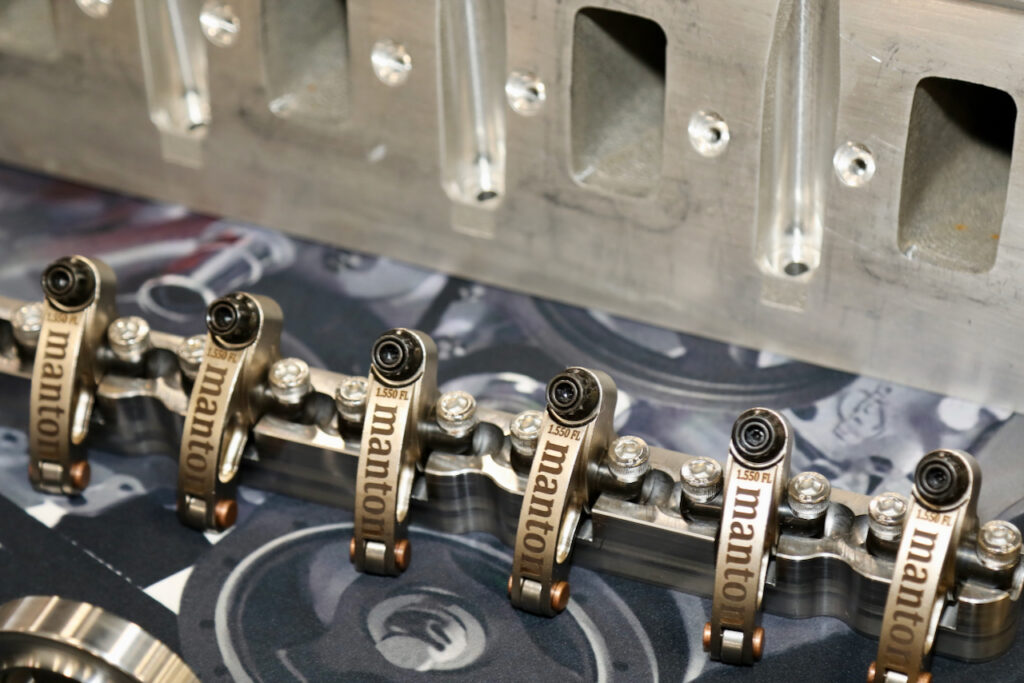
The heads are somewhat of a hybrid between LS7 and LS3, according to Gartrell. There’s the LS7 12-degree valve angle and 300cc intake ports. Flowbench testing revealed 400 cfm at .800-inch lift on the intake side and 256 cfm at .900-inch lift on the exhaust. The heads are also cast from A356-T6 aluminum and sport a thick .750-inch deck. Additional features include CHE bronze valve guides, 67cc combustion chamber and LS7 style rocker arms—although the heads can be machined for aftermarket shaft-mount rockers. The 2.250- and 1.600-inch valves are supplied by Manley, and PAC made the dual valve springs and titanium retainers. XR10 designed the valve covers.
The rotating assembly is anchored by a Scat fully counterweighted billet crankshaft and includes Oliver connecting rods and CP-Carrillo pistons that provide a 12.5:1 compression ratio. Other engine internals include Clevite bearings, P1 Manufacturing fasteners, Cometic MLS gaskets, Isky lifters, Rollmaster timing chain and Manton pushrods.
Roberts improved the oiling system when designing the block. XR10 fabricated an aluminum oil pan for the test mules and uses a factory LS oil pump, although there are plans in place to develop a dry-sump system as horsepower goals increase.
The team is experimenting with different intake manifolds. The 1,003-horsepower dyno run was conducted with an FDM-printed intake from Square Root Fabrication and a Nick Williams 120mm throttle body. The LS3 style fuel injectors are from Deatschwerks, while the MaxxECU Pro is one of the few ECUs on the market that can properly control the odd-fire 10-cylinder spark and fuel delivery. Dustin Clevenger handled the calibration strategy.
The marine market may draw the early attention to this engine, with other opportunities sure to follow. “The boat guys, of course, have called and asked about it. But we always thought the custom car builders would like it,” adds Gartrell. “I do custom car builds, and I always thought that was where a lot of people would buy it; although, obviously it’s an expensive project. And now, I’m thinking about drifters. I didn’t think about them early on, but they’ll like this small package, light weight and the horsepower. We’re planning to have them on sale by Q1 2026.”
